Elgar’s Bow
The Elgar Violin Bow Project
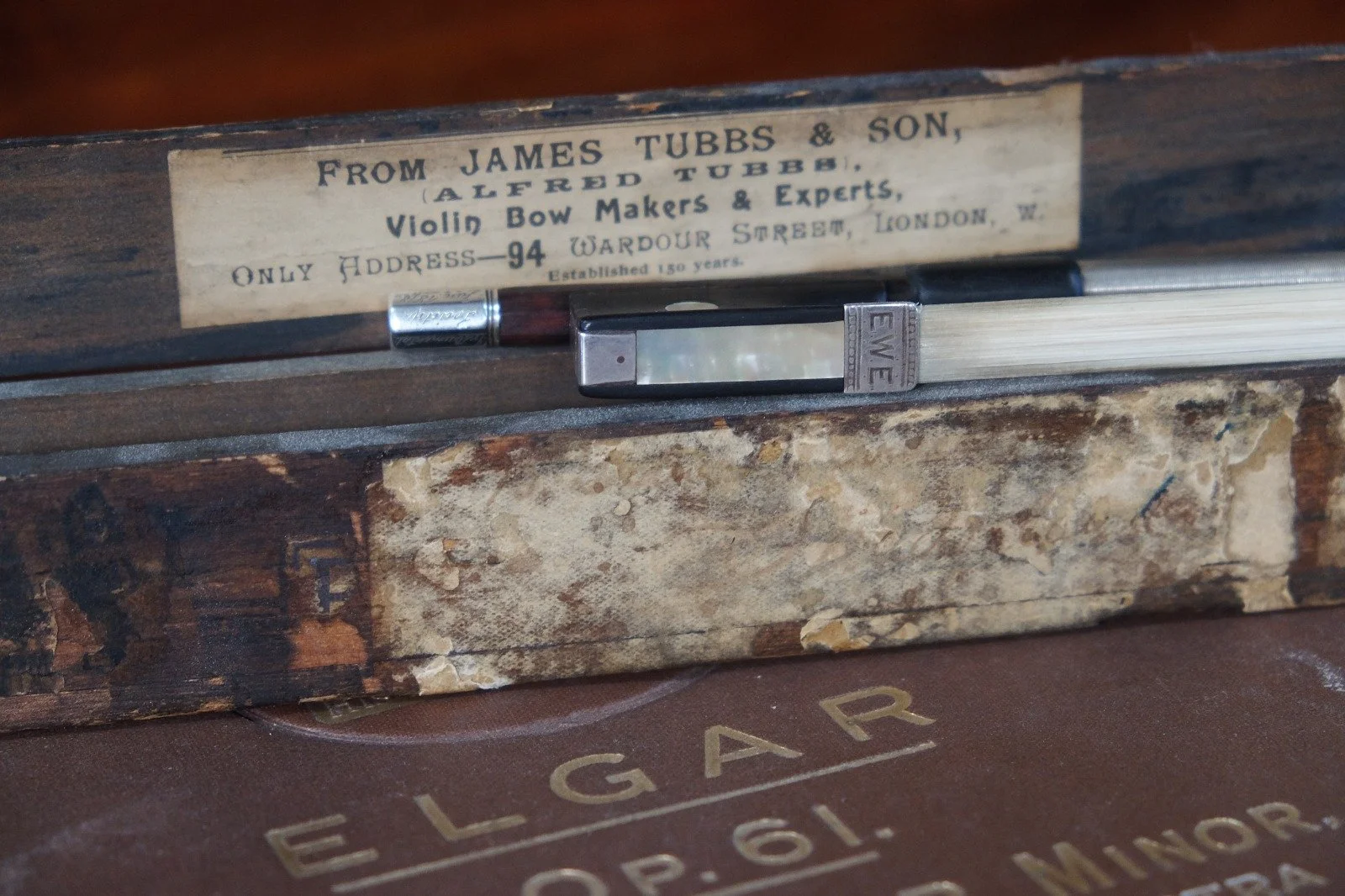
Elgar kept this bow for most of his life, until just before Albert Sammons’ 21st performance of Elgar’s Violin Concerto, when Elgar gifted the bow to him – entrusting it to the violinist who would become most closely associated with the concerto itself. It is extraordinary to consider that this very bow would most likely have been in Elgar’s hand while composing much of his violin music, including the concerto.
I am extremely grateful to Benjamin Hebbert for kindly lending me the use of Elgar’s bow for this and future projects.
Not long before beginning my Advanced Diploma at the Royal Academy of Music, I was introduced to one of the most extraordinary musical artefacts I have ever encountered: Edward Elgar’s bow.
Made by Tubbs as a 21st birthday gift for Elgar, the bow is inscribed “EWE” on the ferrule, and “presented by the Worcester Amateur Instrumental Society Jun[e] 1878” on the adjuster. At that time, Elgar was their concertmaster, and his teacher Adolf Pollitzer believed he had the potential to become one of the leading violin soloists of his generation.
Discovering Elgar Through His Bow
From the moment I first played Elgar’s bow, I felt an immediate connection to his musical language. Its distinctive tip-heavy balance, with a slight ‘drag’, produces a deeply rich, generous sound. The bow almost feels like it sticks to the string, making bow changes effortlessly smooth, and tricky string-crossings – like those in Elgar’s violin Sonata – much easier to control.
Elgar’s writing feels as if it was made for this bow: long lines, harmonic warmth, and emotional breadth emerge with remarkable ease. While the balance might, on paper, make fast or virtuosic passages challenging, in the concerto it simply works – his writing style fits the bow perfectly, allowing even the most demanding passages to flow naturally.
Playing with the bow inspired me to explore projects that bring its voice to life. My first was at the Royal Academy of Music for my final recital, using five different bows for five composers, including a couple of short pieces by Elgar. It was during this preparation that the idea of performing the full Elgar Violin Concerto with his bow first took shape.
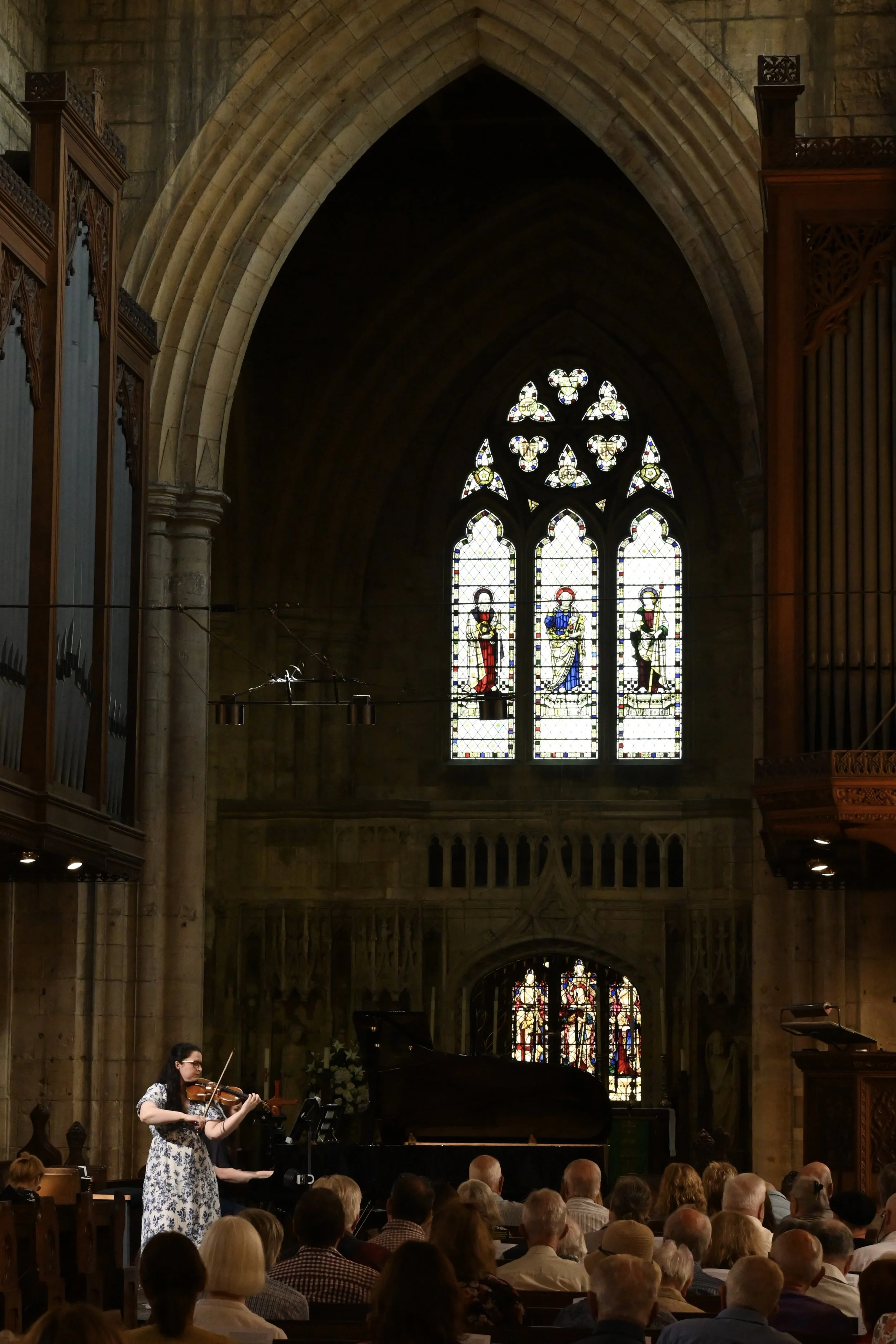
The Elgar Bow Project at Howdenshire Music 2026, performing Elgar’s Sonata and other works to a full-capacity audience. Photo credit: Catherine Marvell
My fascination with the relationship between bows, sound and repertoire has long been part of my artistic approach. Following my performance of Tchaikovsky’s Violin Concerto with the Worcestershire Symphony Orchestra, Lucas Ball of Classical Music Daily noted my interest in “the development of the violin bow and its impact on different repertoire“, suggesting that this exploration contributed to the “romantic energy“ of the performance.
Therefore, encountering Elgar’s own bow felt like a quiet confirmation rather than a novelty – a meeting point between history, craft, and musical instinct.
The Elgar Bow Project continues to evolve, exploring not only the concerto but also Elgar’s chamber music and shorter works for violin. The bow’s unique character; its warmth, depth of colour and expressive flexibility offers a fascinating perspective on the sound world behind Elgar’s writing.
Following a recent recital at Howden Minster featuring Elgar’s Sonata and other works, Seen and Heard International described the performance as:
“An imposing interpretation.”
The review highlighted the “confessional intimacy” of the Sonata’s central Romance, praising its “ardent expressivity” and the conviction of the performance.
The Elgar Violin Concerto
In October 2024, I had the great pleasure of performing Elgar’s Violin Concerto with the Hertfordshire Philharmonia using Elgar’s own bow. The performance was warmly received, culminating in a standing ovation, and marked a deeply meaningful realisation of a project I had dreamt about since first encountering the bow.
Playing the concerto with the very tool that once belonged to Elgar himself offered an intimacy with the music that is difficult to describe, but impossible to forget.
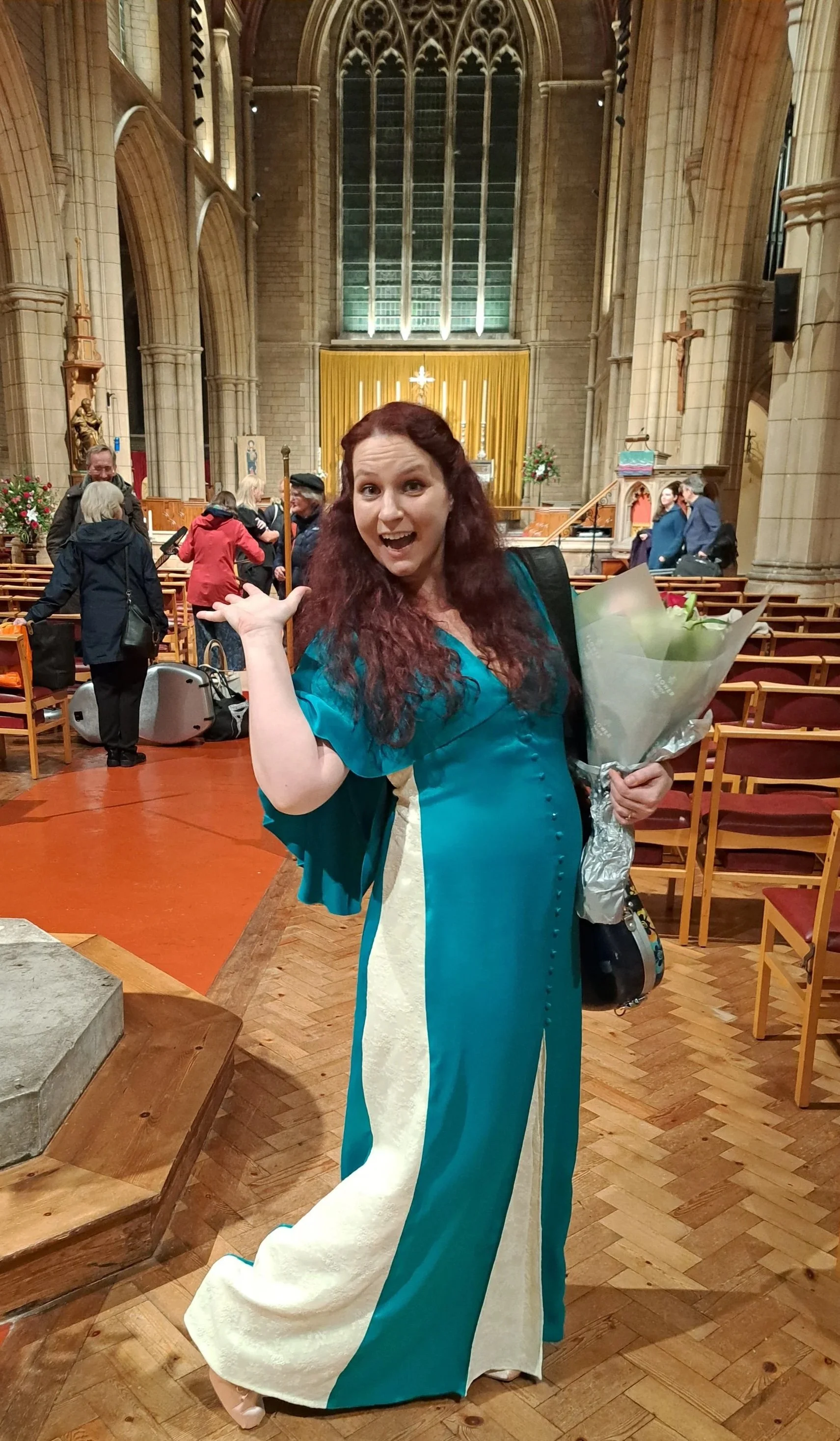
After the performance of Elgar’s Violin Concerto with Hertfordshire Philharmonia, October 2024.
A remarkable connection
I performed the concerto on my own violin – only later discovering it was a rare Daniel Parker (often called the “English Stradivarius”). Interestingly, Fritz Kreisler fell in love with a Parker violin in 1910 while visiting the Hill shop in London, purchased it, and called it his “Parker Strad”, which may well have been the instrument he used to premiere Elgar’s Violin Concerto.
The coincidence of performing Elgar’s concerto on a Parker violin, alongside the historic bow gifted to Elgar himself, created a unique connection between the instrument, the composer and the music – one that continues to inspire my exploration of Elgar’s sound world.
“The best performance of the concerto I have ever seen.”
– member of the Elgar Society
First rehearsal with Elgar’s bow and Hertfordshire Philharmonia, October 2024
The Elgar Bow Project in Performance
The Elgar Bow Project can be presented in a variety of formats, from performances of Elgar’s Violin Concerto with orchestra to carefully curated recital programmes exploring Elgar’s music alongside works from the wider violin repertoire.
Programmes can be tailored to suit orchestras, festivals and concert series, with the option of including informal pre-concert introductions sharing the history of the bow and the ways in which it has shaped my interpretation of Elgar’s music.
For bookings and enquiries, please visit my Contact page to reach me directly or contact my manager via Eva Artistic Management.